How to Choose a Hand in American Mah Jongg
June 24, 2026 · Bird Bam
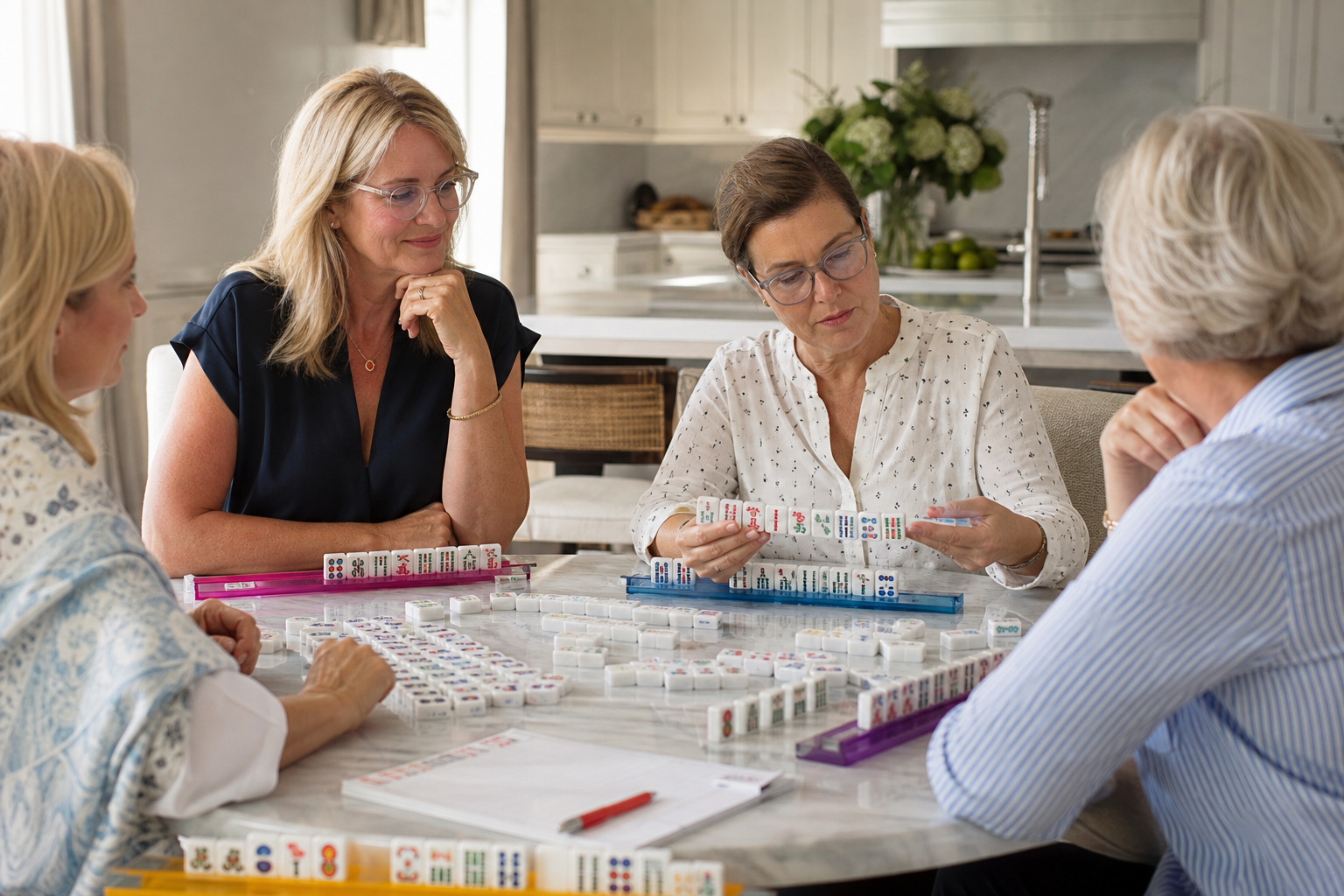
Choosing a hand in American Mah Jongg means matching your starting tiles to the current NMJL card, then committing only when your tiles, jokers, and exposures point in the same direction. A good beginner goal is not to find the "perfect" hand immediately; it is to narrow from several possible sections to one or two realistic hands before the Charleston ends.
What should you look for before choosing a hand?
Start by sorting your rack into useful clues instead of staring at all 13 tiles at once. Look for pairs, related numbers, repeated suits, dragons that match suits, flowers, and jokers. Then compare those clues to the NMJL card and ask: "Which hands already use the most tiles I have?"
A practical first pass looks like this:
- Group by suit and number. Put dots, bams, craks, winds, dragons, flowers, and jokers where you can see patterns.
- Circle the strongest tiles mentally. Pairs, jokers, flowers, and three or more related numbers are more informative than single random tiles.
- Scan the card by section. Do not read every hand equally. Start with sections that match your strongest clue.
- Count committed tiles. A hand that uses 6 of your tiles is usually a better candidate than a hand that uses 3, even if the 3-tile hand looks exciting.
- Check whether the hand is open or concealed. Concealed hands limit calling, so they need stronger starting support.
A simple decision table for beginners
Use this table during the Charleston or early game to decide whether a possible hand is worth pursuing.
| Rack clue | What it may suggest | Beginner action |
|---|---|---|
| Two or more flowers | Flower-heavy hands or sections using flowers | Keep flowers until you see a clearer direction |
| A pair plus a joker | A hand needing multiples of that tile | Protect the pair and joker while scanning matches |
| Three related numbers in one suit | Consecutive-run or number-pattern hands | Compare exact numbers before committing |
| Strong tiles in two suits | Hands that split suits | Keep both paths open through early passes |
| Mostly singles with no pattern | No clear hand yet | Pass safest unrelated tiles and keep flexible clues |
| A likely concealed hand | Higher discipline needed | Choose it only with enough natural tiles already in hand |
This is not a replacement for the NMJL card. It is a way to read your rack faster so the card becomes easier to use.
How many tiles should match before you commit?
A helpful beginner benchmark is five or more useful tiles toward one hand by the end of the Charleston. Six or seven is stronger. Four can be workable if you have jokers, a strong pair, or multiple tiles that also fit a backup hand.
For example, suppose your rack includes two 3s in dots, one 4 dot, one 5 dot, a joker, and a matching dragon. You should scan the card for hands that use those numbers, that suit, or that dragon relationship. If one hand uses the pair of 3s, the 4-5 sequence, and the joker, it may be a better direction than a hand that only uses the dragon and one number.
The key is to count tiles that actually fit the printed pattern. A tile is not "close" just because it is in the same suit; it must be able to occupy a real spot in the hand.
Keep a backup hand as long as possible
Intermediate players improve quickly when they stop treating the first idea as final. During the Charleston, try to keep two compatible paths alive. Compatible paths share tiles, suits, numbers, or flowers, so you can pivot without rebuilding your rack from scratch.
A good backup plan has three traits:
- It uses several of the same tiles as your main plan.
- It does not require passing away your best pair or joker.
- It gives you a legal direction if another player exposes tiles that make your first plan risky.
If your main hand and backup hand need completely different tiles, you do not really have a backup. You have two weak guesses.
When should you switch hands?
Switch when the evidence on the table is stronger than your original plan. Clear reasons to switch include:
- You are still three or more specific tiles away after several turns.
- Another player exposes tiles that make your needed tiles less available.
- You draw into a stronger pattern that uses more of your rack.
- You realize your chosen hand is concealed and you have already been relying on calls.
Do not switch because of one frustrating draw. Switch because your tile count, available calls, and the NMJL card now point somewhere better.
Common hand-choice mistakes
The most common beginner mistake is choosing a hand because it has a high point value or looks familiar from last week. In American Mah Jongg, the best hand is usually the one your rack can realistically complete, not the one you wish your rack supported.
Another mistake is passing away flexible tiles too early. Flowers, jokers, pairs, and tiles that fit multiple sections deserve more caution than isolated singles. During early Charleston passes, get rid of tiles with the least connection to your strongest clues.
Finally, do not ignore open versus concealed status. If a hand is concealed, you cannot use normal discard calls to build exposed sets for that hand. That makes concealed hands powerful but less forgiving.
How Bird Bam helps at the table
Hand choice gets easier when the table flow stays organized. Bird Bam is an iOS American Mah Jongg scoring and community/group-play app that helps players keep score, track hands and games, reduce scorekeeping friction, and keep attention on the game instead of messy paper notes.
Bird Bam does not replace the current NMJL card, and players still need the card to choose legal hands. But when your group has a cleaner way to record games and scores, beginners can spend more energy learning patterns, Charleston decisions, and table rhythm.
If your group wants a cleaner way to keep score, Bird Bam gives your table a simple iOS companion for American Mah Jongg.
FAQ
Should beginners choose a hand before the Charleston?
No. Before the Charleston, identify two or three possible directions. Commit later, after passes and draws show which direction has the strongest tile support.
Is it better to choose a high-value hand?
Not automatically. A lower-value hand with six or seven useful tiles is often a better choice than a higher-value hand with only three useful tiles. Completion odds matter more than printed value early in the game.
How many backup hands should I track?
Track one serious backup hand, not five vague possibilities. Too many options make discards and calls confusing.
Can Bird Bam help me choose the NMJL hand?
Bird Bam helps with American Mah Jongg scorekeeping and group play, but players should use the current NMJL card to identify and choose legal hands.