Best Ways to Learn American Mah Jongg as a Beginner
June 16, 2026 · Jannet
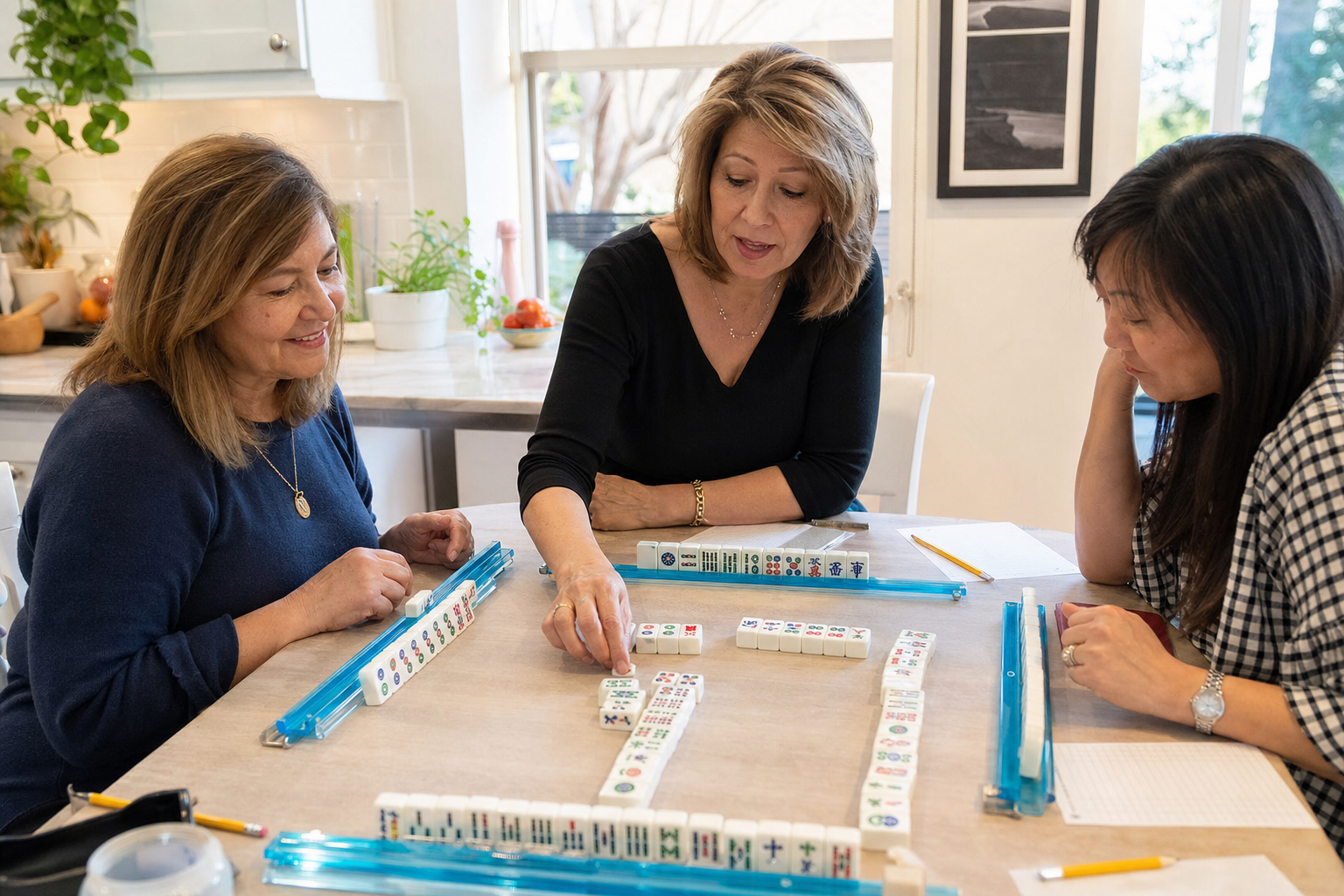
The best way to learn American Mah Jongg is to combine three things: learn the structure of the game, sit with patient players, and practice with the current NMJL card in front of you. New players do not need to memorize the whole card at once; they need a repeatable learning path that makes each hand less confusing.
Best way to learn American Mah Jongg as a beginner
American Mah Jongg can feel overwhelming because there are tiles, racks, the Charleston, jokers, exposures, scoring, and an annual National Mah Jongg League card. The fastest beginner path is not to master everything in one sitting. It is to learn the game in layers.
A good learning order looks like this:
- Learn the tile suits and basic tile names.
- Understand what a valid hand looks like on the NMJL card.
- Practice the Charleston slowly.
- Learn when you can call for a discard.
- Play open-handed practice rounds.
- Add scoring once the flow of the game feels familiar.
That sequence gives new players confidence without asking them to absorb every rule at once.
Start with the tiles, not the strategy
Before a new player worries about winning, they should be comfortable recognizing the tiles. American Mah Jongg uses suits, winds, dragons, flowers, jokers, and sometimes blanks depending on the set.
Beginners should be able to answer simple questions quickly:
- Which tiles are dots, bams, and craks?
- Which tiles are winds and dragons?
- Which tiles are flowers?
- What does a joker do?
- Which tiles are not interchangeable?
This sounds basic, but it removes a lot of table anxiety. If a player is still hunting for tile names, the card and strategy will feel much harder than they really are.
Learn the NMJL card in small sections
The NMJL card is the center of American Mah Jongg, but beginners should not try to memorize it. A better approach is to learn how to read the card.
Focus on:
| Card element | What beginners should learn |
|---|---|
| Sections | The card is organized into hand categories. |
| Colors | Colors show suit relationships, not necessarily tile colors. |
| Numbers and letters | These represent exact tile patterns. |
| Parentheses or notes | These may explain restrictions or special rules. |
| Printed values | These are used for scoring after Mah Jongg. |
A new player should practice pointing to a hand and explaining what it requires. That skill matters more than memorizing a list of hands.
Play open-handed practice rounds
One of the best ways to teach American Mah Jongg is to play a few hands with everyone’s tiles visible. Open-handed rounds remove the pressure of secrecy and let beginners hear the reasoning behind each decision.
During an open-handed round, experienced players can explain:
- Why a tile is useful or not useful
- When a hand is becoming unrealistic
- Why a player might switch hand direction
- Which discards are safer or riskier
- When a joker can help and when it cannot
This turns the game into a conversation instead of a memory test. It also helps new players understand that American Mah Jongg is about adapting, not simply waiting for one perfect tile.
Teach the Charleston slowly
The Charleston is often the first moment where beginners feel lost. They may understand their tiles, then suddenly have to pass tiles before they know what they are building.
To teach it well, slow down and explain the goal: the Charleston helps players improve their starting hand by passing tiles they are less likely to use. New players should look for pairs, related numbers, flowers, jokers, and patterns that could connect to the card.
A helpful beginner rule is: do not pass jokers, and be careful about passing obvious pairs unless you truly have no direction. The finer strategy can come later.
Add scoring after the game flow makes sense
Scoring is important, but it is not the first thing a brand-new player needs to master. Once a beginner understands the flow of play, scoring becomes easier because the winning hand can be matched to the NMJL card.
The basic scoring habit is:
- Leave the winning tiles visible.
- Match the hand to the card.
- Read the printed value.
- Apply your table’s payout or point rules.
- Record the score before tiles are mixed back in.
That final step matters. Many beginner groups remember who won but lose track of the score because the table moves too quickly into the next hand.
How Bam helps new players learn at the table
Learning American Mah Jongg is easier when the table feels organized. Bam gives groups a cleaner iOS companion for American Mah Jongg scorekeeping and group play, so beginners are not also trying to manage messy paper notes while learning tiles, hands, and table flow.
For new players, the biggest benefit is reducing friction. If the table can keep scores and hands organized, the experienced players can spend more attention explaining why a discard mattered, how a hand matched the card, or what happened during the Charleston.
Bam does not replace the current NMJL card. Players still need the card to choose hands and verify values. But for groups that want a smoother learning environment, Bam helps keep the table focused on playing together instead of debating what was just recorded.
A simple four-week learning plan
A new player can make real progress with a simple plan:
Week 1: Tiles and table rhythm
Learn tile names, rack setup, the wall, turns, drawing, discarding, and basic table etiquette. Do not worry about advanced strategy yet.
Week 2: Reading the card
Practice reading several hands from the NMJL card. Learn what the colors mean, how pairs differ from groups, and why concealed hands matter.
Week 3: Charleston and calling
Focus on passing strategy, when to call for a discard, how exposures work, and why some hands remain flexible longer than others.
Week 4: Real games with scoring
Play normal hands, verify wins out loud, and record scores consistently. At this stage, the player should start learning from repetition.
What new players should avoid
Beginners usually struggle when they try to do too much too early. Avoid these common traps:
- Trying to memorize the entire card
- Playing too fast before understanding the flow
- Changing hands every turn without a reason
- Ignoring table etiquette around discards and calls
- Learning scoring before understanding valid hands
- Feeling embarrassed about asking questions
American Mah Jongg is a social game. A good table wants new players to learn, ask questions, and come back.
Frequently asked questions
How long does it take to learn American Mah Jongg?
Most beginners can understand the basic flow after a few sessions, but feeling comfortable with the card and strategy takes longer. The game becomes much easier with repeated play.
Should beginners memorize the NMJL card?
No. Beginners should learn how to read the card, not memorize it. The card changes each year, so card-reading skills matter more than memorization.
Is it better to learn online or in person?
In-person learning is usually best because American Mah Jongg has a strong table rhythm and social etiquette. Online resources can help reinforce rules between games.
What should a beginner bring to their first game?
Bring the current NMJL card if you have one, a willingness to ask questions, and patience. If your group uses the app Bird Bam, you can also keep score more cleanly while everyone focuses on learning the game.