American Mah Jongg Exposures: When to Call a Discard
June 18, 2026 · Bird Bam
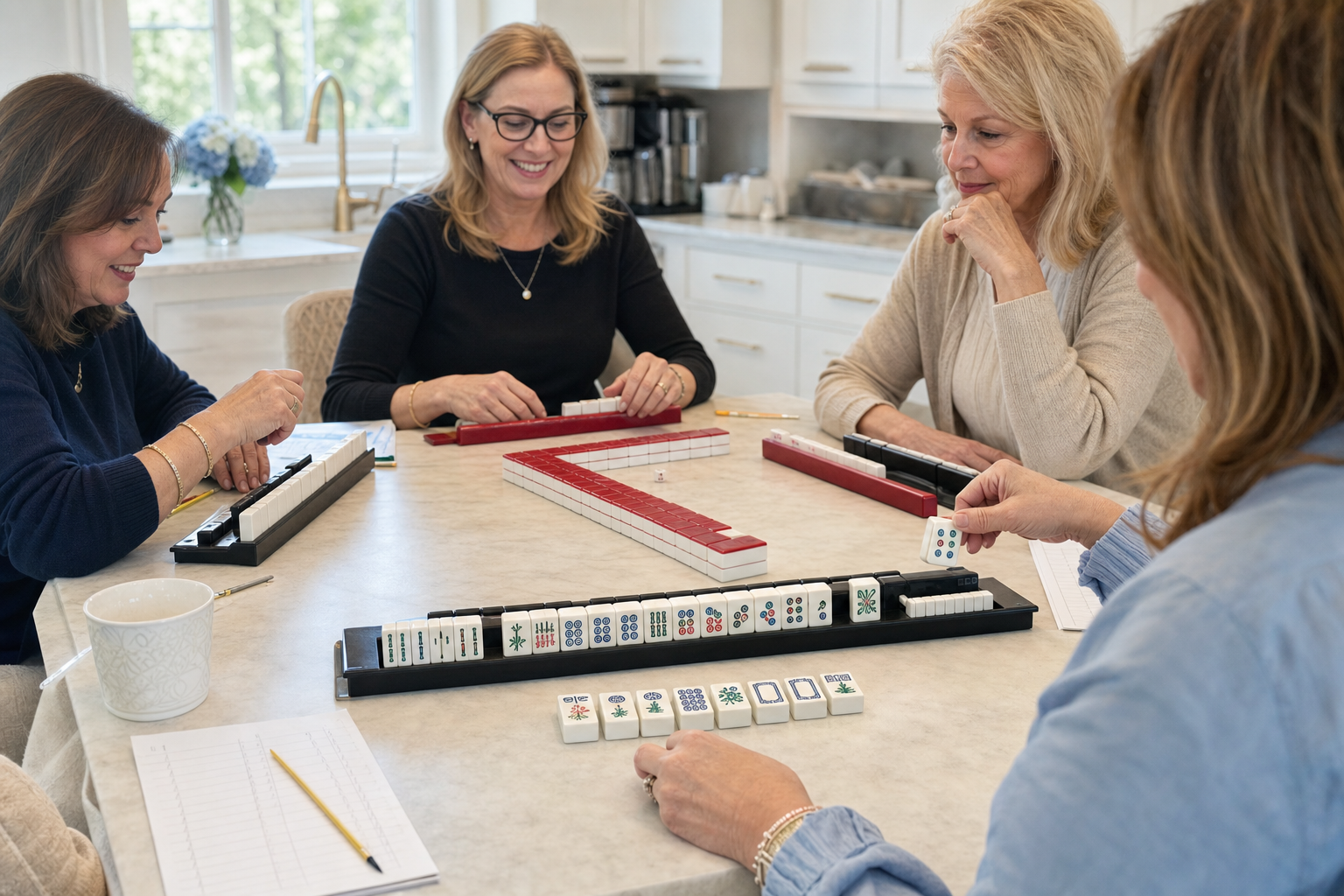
American Mah Jongg exposures are face-up tile sets claimed from another player’s discard, and they tell the table a lot about your hand. Beginners should know three things right away: you may expose only when a discard completes a valid set for the hand you are playing, an exposure commits those tiles face up for everyone to see, and some NMJL card hands are marked concealed and cannot use exposures at all.
When should you call a discard and expose tiles?
Call a discard when it directly completes a pung, kong, quint, or other required grouping for a hand on the current NMJL card and moving those tiles face up helps you get closer to Mah Jongg. Do not call just because the tile is useful. In American Mah Jongg, calling a discard is not a way to collect a single tile for your hand; it is a public claim that completes an exposed set.
A practical beginner test:
- Find the exact line on the NMJL card you are trying to make.
- Confirm the discarded tile completes one of that line’s groups.
- Check whether the hand is concealed. If it is concealed, do not call for exposure.
- If the hand allows exposure, place the completed group face up on your rack.
- Discard one tile to end your turn.
That short checklist prevents the two most common beginner mistakes: exposing for a hand that must stay concealed, and exposing tiles that do not actually match the hand.
What counts as an exposure in American Mah Jongg?
An exposure is a completed group of tiles placed face up after you claim another player’s discard. The group stays open for the rest of the hand. Once exposed, those tiles are part of your public hand and cannot be hidden again.
Common exposed group types include:
| Group type | What it means | Beginner note |
|---|---|---|
| Pung | Three identical tiles | Often called when the discard gives you the third matching tile |
| Kong | Four identical tiles | May include jokers if the hand and grouping allow jokers |
| Quint | Five identical tiles | Requires jokers because there are only four of any natural tile |
| Year or number group | A required pattern from the NMJL card | Follow the current card exactly without copying card hands into notes |
Pairs are different. Under standard American Mah Jongg conventions, jokers cannot be used in pairs, and a discarded tile is not normally called just to complete a pair unless it is the tile that gives you Mah Jongg. That distinction matters because many near-wins fail when a beginner treats pairs like regular exposed groups.
How exposures change table information
Every exposure gives your opponents clues. If you expose three red dragons, the table can narrow the hands you might be playing. If you expose a kong with jokers, other players can watch for the matching natural tile and may be able to exchange for one of those jokers.
Before calling, ask yourself what the exposure reveals:
- Does it clearly point to one section of the NMJL card?
- Does it make your hand easier for opponents to block?
- Does it put a joker on the rack where another player might exchange it?
- Does it still leave you with a realistic path to finish?
Exposing is not bad. In fact, many strong hands are meant to be played open. The key is to expose with a purpose instead of reacting to every useful-looking discard.
Concealed hands: the rule beginners must notice
If a hand is marked concealed on the NMJL card, you cannot make exposures for that hand. You must build it from your own draws and discards, keeping the hand hidden until you declare Mah Jongg.
A simple example: suppose you are aiming for a concealed hand and another player discards the exact tile that would complete a pung for you. Even though the tile fits your pattern, calling it would break the concealed requirement. The correct play is to let it pass unless that tile is the final tile that lets you declare Mah Jongg according to your table’s rules.
This is why experienced players scan the card notation before they chase a hand. The word or marker for concealed is not decoration; it changes how you are allowed to complete the hand.
Jokers and exposed sets
Jokers are allowed in many exposed pungs, kongs, and quints, but they are not universal wild cards for every part of the card. The most important beginner rules are:
- Jokers can represent tiles in many groups of three or more.
- Jokers cannot be used in pairs.
- A joker in an exposed set can be exchanged by another player who has the matching natural tile.
- A joker cannot fix a hand that does not match the NMJL card structure.
Here is a concrete flow. You expose a kong of four matching tiles and one of those tiles is a joker. Later, another player draws the natural tile that the joker represents. On that player’s turn, they may exchange the natural tile for your exposed joker, then continue their turn. That is one reason exposing jokers can help you advance but also create opportunity for the rest of the table.
Confirm your table’s house rules before play.
A beginner decision chart for exposures
Use this quick table when a discard tempts you:
| Question | If yes | If no |
|---|---|---|
| Does the tile complete a required group? | Keep checking | Do not call |
| Is the hand allowed to be exposed? | Keep checking | Do not call unless it is for Mah Jongg |
| Will the exposure leave a clear path to finish? | Consider calling | Usually pass |
| Are you exposing a joker? | Know it may be exchanged | Less risk to expose |
| Does calling reveal too much? | Call only if the gain is worth it | Passing may be stronger |
Beginners often improve quickly by calling fewer discards, not more. Passing a tempting tile is correct when the exposure would commit you to a weak path or reveal your plan too early.
How Bird Bam helps at the table
Exposures create moments when the table has to keep the hand, score, and game flow straight at the same time. Bird Bam is an iOS American Mah Jongg scoring and community/group-play app that helps players keep score, track hands and games, reduce scorekeeping friction, and keep attention on playing together.
Bird Bam does not replace the current NMJL card, and players still need to read the card carefully for exposed and concealed hand requirements. It fits best as a simple companion for groups that want cleaner scorekeeping while they focus on decisions like when to call, when to pass, and how to keep the game moving.
If your group wants a cleaner way to keep score, Bird Bam gives your table a simple iOS companion for American Mah Jongg.
FAQ
Can I call a discard for a single tile I need?
No. In standard American Mah Jongg, a discard call is used to complete an allowed exposed group or to declare Mah Jongg. You do not call a discard simply to add one useful tile to your rack.
Can I expose a pair with a joker?
No. Jokers cannot be used in pairs under standard NMJL-style American Mah Jongg rules. If a hand requires a pair, you need the natural tiles for that pair.
Are concealed hands harder for beginners?
They can be harder because you cannot rely on calling discards for exposures. Beginners should still learn them, but it helps to practice reading the concealed marker on the NMJL card before choosing a hand.
Should I always exchange for an exposed joker?
If you have the matching natural tile and the exchange helps your hand, it is often valuable. But do not trade away a tile you need for your own hand unless the joker improves your position more than the natural tile does.