Charleston Strategy for American Mah Jongg Beginners
June 16, 2026 · Bam
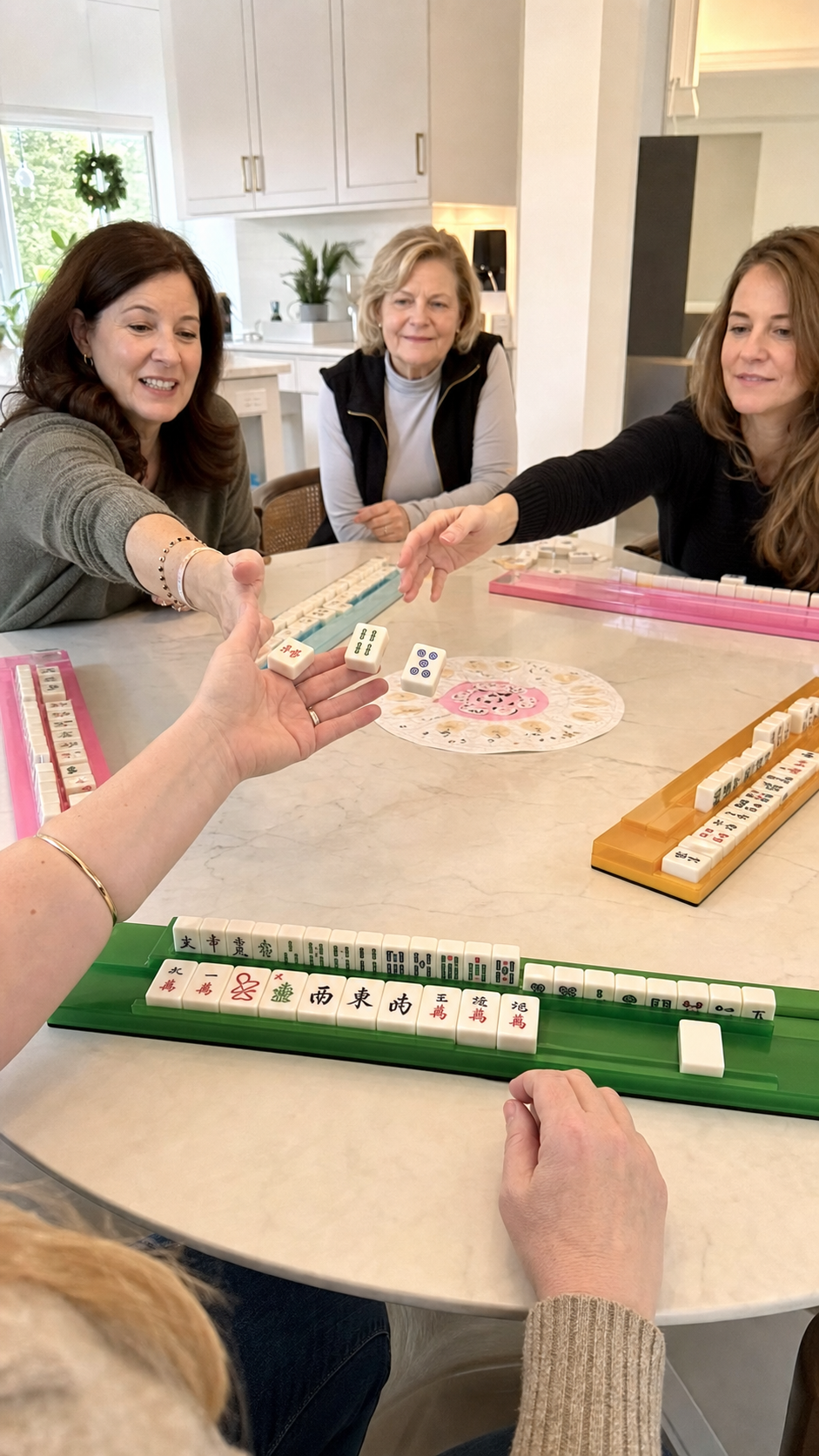
The Charleston in American Mah Jongg is the three-tile passing sequence at the start of many hands. For beginners, the best Charleston strategy is to keep tiles that point toward two or three possible hands, pass isolated tiles that do not connect to your plan, and avoid giving away jokers or useful pairs. You do not need to know your final hand before the Charleston ends; you need to improve your options.
What the Charleston is trying to accomplish
The Charleston is not random tile swapping. It is the first strategic decision point in American Mah Jongg. Each player passes three tiles at a time, giving away tiles they are less likely to use while hoping to receive tiles that strengthen a possible hand on the current NMJL card.
The goal is simple: after the Charleston, your rack should have more direction than it did when you picked up your starting tiles.
A beginner should ask three questions before each pass:
- Which tiles are already working together?
- Which tiles are isolated from every realistic hand I might play?
- Am I accidentally passing something valuable to another player?
If you can answer those three questions, you are already playing the Charleston more intentionally than most new players.
The basic Charleston order
American Mah Jongg groups commonly use this Charleston sequence:
| Step | Pass direction | What happens |
|---|---|---|
| First right | Pass 3 tiles to the player on your right | Everyone passes at the same time. |
| Across | Pass 3 tiles across the table | Everyone passes to the opposite player. |
| First left | Pass 3 tiles to the player on your left | This completes the first Charleston. |
| Optional second left | Table may continue if all agree | Some groups play a second Charleston. |
| Across again | Pass 3 tiles across | Part of the second Charleston. |
| Right again | Pass 3 tiles right | Ends the second Charleston. |
| Courtesy pass | Optional 0–3 tile exchange with the opposite player | Both players agree on how many to exchange. |
Before you play, confirm whether your table uses the second Charleston and the courtesy pass. Many groups do, but a table should agree before the first hand begins.
What beginners should keep
During the Charleston, keep tiles that create flexibility. A tile is flexible when it can contribute to more than one possible hand on the NMJL card.
Good candidates to keep include:
- Pairs, especially if they appear useful for several hands
- Jokers, because they can complete many groups
- Flowers, if your card direction needs them
- Number runs or clusters, such as related numbers in one suit
- Tiles that match a likely card section, even if you are not locked in yet
For example, if your rack has several bams around the same number range, you may not know the exact hand yet. But that cluster gives you a direction. Passing those tiles too early can destroy your best option.
What beginners should pass
The easiest tiles to pass are isolated tiles: tiles that do not connect to your pairs, suits, numbers, or likely sections of the card.
A beginner-friendly passing order is:
- Pass isolated winds or dragons if they do not support your direction.
- Pass single numbers that do not connect to any nearby tiles.
- Pass flowers only if they do not help your likely hands.
- Avoid passing pairs unless you are certain they do not fit.
- Never pass jokers.
The most common beginner mistake is passing three tiles just because they look unrelated at first glance. Take a few seconds to compare them with the card. A tile that looks useless may support a hand you have not noticed yet.
Never pass jokers
Jokers are among the most powerful tiles in American Mah Jongg because they can stand in for tiles in eligible groups such as pungs, kongs, quints, and sextets. They cannot be used for singles or pairs, but they still create flexibility that beginners should protect.
A simple rule is enough: do not pass jokers during the Charleston.
Even if a joker does not fit your first idea, it may fit your second or third idea after the pass. Giving it away gives another player flexibility for free.
Be careful with pairs
Pairs are important because some hands require exact pairs, and jokers cannot usually replace a pair. That makes real pairs more valuable than many beginners realize.
Do not automatically keep every pair forever, but be slow to pass them. Before passing a pair, ask:
- Does this pair appear in any hand I might play?
- Could it support a concealed hand?
- Is this pair harder to rebuild later?
- Am I passing both copies to the same player?
If you are unsure, keep the pair through at least the early Charleston and pass more isolated tiles instead.
How to choose a direction without locking in too early
The Charleston rewards flexible planning. Beginners often make one of two mistakes: they either pick a hand too early and force it, or they never pick a direction at all.
A better middle path is to leave the Charleston with two or three possible hands. You might think, “I have a good dots direction, a possible consecutive run, and a flower option.” That is enough.
After the Charleston, your draws and discards will tell you which path is strongest.
How Bird Bam helps during learning games
The Charleston is easier to learn when the rest of the table feels organized. Bird Bam helps groups keep score, track hands and games, and reduce the paper clutter that can distract new players from learning the actual decisions in front of them.
For a beginner table, that matters. If one person is trying to teach the Charleston, explain discards, verify hands, and manage scoring on paper, the game slows down. Bird Bam gives the group a cleaner iOS companion so the teaching can stay focused on questions like “why did we keep this pair?” or “which hand are these tiles pointing toward?”
Bird Bam does not replace the current NMJL card. Players still need the card to choose and verify hands. But if your group wants learning games to feel less chaotic, Bird Bam helps keep the table organized while everyone practices.
Quick Charleston checklist for beginners
Before each pass, use this checklist:
- Keep jokers.
- Think twice before passing pairs.
- Keep tiles that support more than one hand.
- Pass isolated tiles first.
- Do not force one hand too early.
- Confirm whether your table uses the second Charleston and courtesy pass.
- Use the NMJL card, not memory, to decide what connects.
Frequently asked questions
Do you have to do the Charleston in American Mah Jongg?
In standard American Mah Jongg, the Charleston is a core part of the game, but table rules and teaching games can vary. Beginners should learn it because it shapes the entire hand.
Can you pass a joker in the Charleston?
You should not pass a joker. Jokers are flexible and valuable, and passing one gives another player a major advantage.
What is the courtesy pass?
The courtesy pass is an optional exchange with the player across from you after the Charleston. Each player may exchange 0–3 tiles, but both players must agree on the number.
Should beginners pick a hand before the Charleston ends?
Beginners should look for direction, not a final commitment. Try to leave the Charleston with two or three possible hands, then narrow your plan as the hand develops.